
Water Sort! 3D Color Match Puz
Flyfox GamesPuzzle
4.9919.00 Reviews
- Version
- 1.2.9
- Installs
- 1.00M
- Age Rating
- Everyone
Screenshots
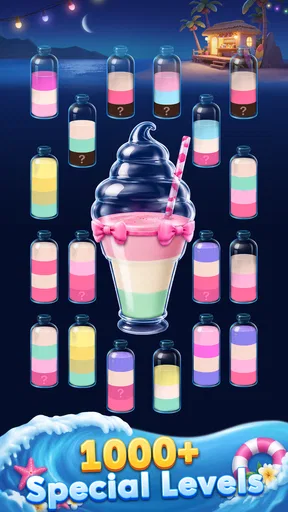
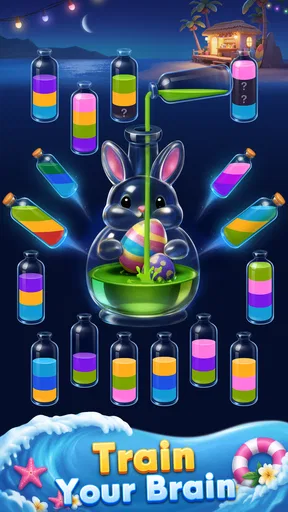
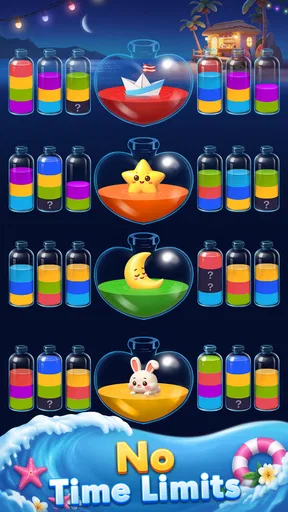
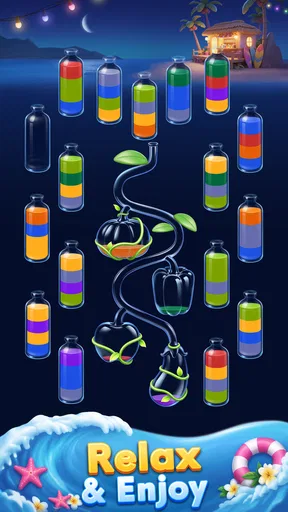
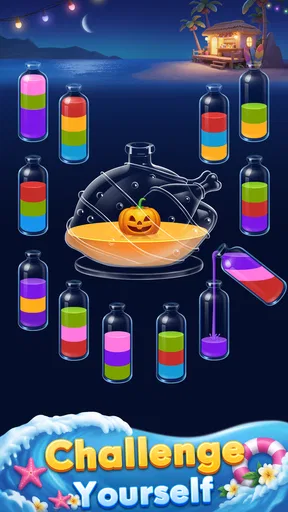
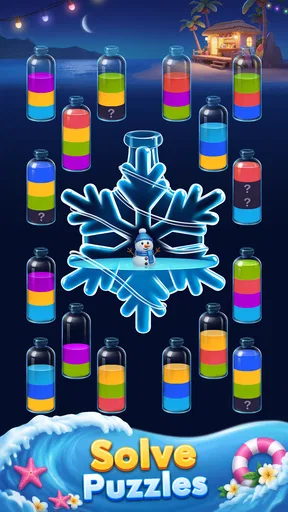
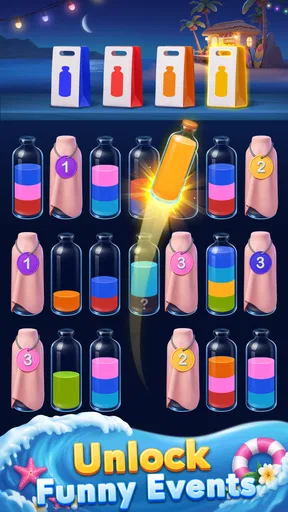
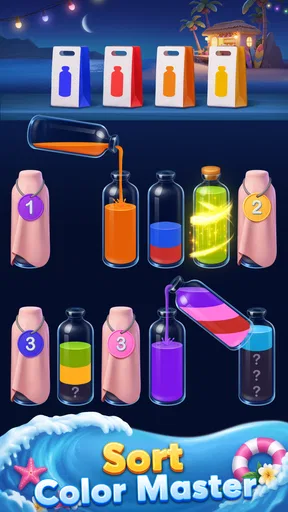
Our Review of Water Sort! 3D Color Match Puz
 Analysis by Appyee
I spent time with Water Sort! 3D Color Match Puz as a casual puzzle game, and its appeal is easy to understand: you move colored liquid between transparent bottles until each bottle contains one color. That familiar idea becomes more pleasant to play here because the presentation is three-dimensional and the actions are deliberately simple. I can pick it up for a short break, solve a few boards, and put it down without needing to remember a complicated story or control scheme.
The game comes from Flyfox Games and is free to download, with optional purchases ranging from $0.99 to $9.99 per item. It is listed for Everyone, so the basic concept is approachable for children and adults alike. At the same time, the later mental challenge is more suitable for players who enjoy planning several moves ahead rather than tapping randomly and hoping the puzzle works out.
How the current version feels to play
The current release is version 1.2.9, and the experience is centered firmly on bottle-sorting puzzles. Each move asks me to judge whether pouring one color into another will create useful space or trap a color beneath something else. The first boards are easy to understand, but the real test comes from recognizing that an apparently helpful pour can remove the only free room I need later.
The three-dimensional look gives the bottles more presence than a flat color grid would have. I can see the liquid levels and the separate color layers, which makes planning feel more physical. That does not turn it into a realistic simulation, nor should it; the visual treatment exists to make a straightforward puzzle more satisfying to handle.
The controls are naturally suited to touch. I select a bottle and then choose where its liquid should go, watching the colors shift as the move is completed. This is the sort of design I prefer for a phone because it avoids small virtual buttons and keeps my attention on the arrangement. If I make a poor decision, the resulting position is immediately visible, so I can usually understand my mistake instead of blaming the controls.
What I like most is the relationship between a move and the next several moves. A good solution is rarely about matching the most obvious colors immediately. I often need to use an empty bottle as temporary storage, expose a hidden layer, and preserve another bottle as a future landing space. That gives the game more depth than its simple appearance suggests.
A useful way to approach difficult boards
My best habit is to count empty space before I pour anything. It is tempting to combine a matching color whenever possible, but a nearly full bottle can become a problem if it prevents access to the color underneath. I first look for moves that uncover a buried layer without filling the last flexible container. This small change in thinking makes the puzzles feel more controlled.
I also avoid treating an empty bottle as a place to dump whatever is convenient. It is better understood as a working tool. If I use it to hold a color that will not be needed for several turns, I may lose the room required to separate two other colors. Keeping one temporary space available is often more valuable than completing a single color early.
Another practical tip is to pause after every pour instead of tapping through a planned sequence too quickly. The new arrangement can reveal a better option than the one I had in mind. This matters particularly on a phone, where a rushed tap can turn a solvable position into one that requires recovery or a restart.
Why it works in everyday play
I see this as a good companion for short, low-pressure moments. Imagine waiting for a coffee, sitting on a train, or taking a few minutes away from work: the game gives me a clear task that can be completed in small sessions. I do not need sound, a long setup, or a large uninterrupted block of time to understand what I am doing.
It also suits people who enjoy visual organization. The satisfaction comes from reducing a messy group of layered colors into clean, completed bottles. That makes it different from a word puzzle, where the reward is finding a hidden answer, and from a match-three game, where speed and chain reactions usually matter more. Here, the main reward is making a careful plan and seeing it work.
For younger players, the basic rules are accessible, but I would still expect the difficulty to become more demanding as the arrangements grow more complicated. Adults who want a quiet logic exercise may appreciate that progression. Players looking for action, competition, or a story-driven reason to continue will probably find the experience too narrow.
What has changed and what that means
The game was released on January 27, 2026, and the current version is 1.2.9. That release history tells me I am looking at a relatively early product that has already moved through several version steps rather than a completely untouched launch build. I would not treat the version number alone as proof of a particular feature, but it does make the current build the sensible one to evaluate rather than an earlier release.
For an existing player, the important point is practical: updating to the current version should be part of normal use, especially if a previous build felt rough or behaved differently. I cannot promise that every personal annoyance has disappeared, but playing the latest release gives the fairest view of Flyfox Games’ present direction. New players also avoid forming an opinion from old footage or outdated screenshots.
The large audience gives the game some useful context. It has passed one million installs, carries an average rating of 4.9 from about 76 thousand ratings, and shows 919 written reviews. Those figures suggest strong overall reception, although they do not tell me whether the game matches my own tolerance for repetition, optional spending, or gradually increasing puzzle difficulty. I read them as a sign that the central loop works for many people, not as a guarantee that every board will suit me.
The free entry point is another reason the current version is easy to try. I can see whether the pouring rules and visual style click with me before spending anything. The optional purchases, priced per item between $0.99 and $9.99, are worth keeping in mind if I am sensitive to in-game costs. A free download is not the same as a completely cost-free experience, so I would make any purchase decision deliberately rather than treating it as part of the basic requirement to play.
The strengths that are easy to miss
The first overlooked strength is the game’s use of temporary disorder. A board may look worse after a correct move because a color has been split across bottles or moved away from its eventual home. That is not necessarily failure. Sometimes the right solution begins by making the layout less tidy so that a blocked layer becomes available. Recognizing this prevents me from restarting simply because the board looks messier for a moment.
The second is the value of planning around bottlenecks. The most important bottle is not always the one with the most attractive color match. It may be the bottle that currently blocks access to a useful layer or the only container that can accept a particular color without wasting space. I now inspect which bottles control future options before deciding which color I want to complete first.
The third is that the game can act as a gentle focus reset. Because each move has a visible consequence, I can concentrate on a small chain of decisions instead of carrying a larger problem in my head. That is a personal use case rather than a promise of a health benefit, but it is one reason I return to this kind of puzzle when I want something absorbing without being loud or demanding.
There is also a trade-off in the three-dimensional presentation. The bottles are more attractive and tactile than plain colored columns, but extra visual polish does not automatically add more puzzle variety. If I already play several water-sorting games, the underlying logic may feel familiar even when the presentation is different. The value depends on whether I enjoy this particular look and handling enough to keep solving.
Where the experience may fall short
The narrow focus is the clearest limitation. This is not a broad puzzle collection with wordplay, physics challenges, or a story between levels. If I want changing rules from one session to the next, I may run out of novelty sooner than I would with a mixed puzzle app. The same bottle-sorting foundation can be relaxing, but it can also feel repetitive when I am not in the mood for careful color management.
The game is also a poor fit for anyone who prefers immediate action. There is no reason to rush the logic itself. The enjoyment comes from thinking, testing a sequence, and correcting a plan. Players who need fast reactions, multiplayer pressure, or a strong competitive ladder should choose a different category rather than expecting this quiet format to become something it is not.
Optional purchases create another point to consider. I can begin without paying, which is helpful, but the presence of item purchases means I should check each prompt before confirming it. For a child using a shared device, I would set up the appropriate purchase protections first. The Everyone rating describes the content, not a promise that every family will want unrestricted spending access.
Finally, the rating should be read with some perspective. A 4.9 average is impressive, but a high score cannot answer personal questions such as whether the later puzzles feel too easy, whether the visual style is comfortable for long sessions, or whether the free experience offers enough variety for a particular player. I use the positive reception as encouragement to try it, then judge it by how often I genuinely want to return.
Who should install it, and who should skip it
I would recommend it to someone who likes sorting, spatial planning, and calm touch controls. It is especially suitable for short sessions because the rules are clear enough to learn immediately and the individual challenge is easy to understand while I am playing. It can also work for a family member who wants a simple logic game rated for Everyone, provided purchases are handled responsibly.
I would skip it if I need a strong narrative, constant novelty, or a competitive reason to keep opening the app. I would also look elsewhere if I dislike repeating a familiar puzzle structure with increasingly complicated arrangements. A general puzzle collection is a better alternative for variety, while a match-three game is better for quick reactions and visual rewards. A traditional logic game may be preferable if I want more formal deduction and less reliance on moving colored layers around.
For someone choosing between this and another water-sorting title, I would focus on handling and presentation rather than expecting a completely new concept. The three-dimensional bottles are the main identity here. If that tactile visual approach makes the act of pouring feel satisfying, this version has a clear reason to earn space on the phone. If I only care about the underlying rules, another app with similar mechanics may provide much the same mental exercise.
What I would watch as the game develops
Because the product is still early in its release life and currently sits at version 1.2.9, I would watch how Flyfox Games handles future updates. The most meaningful progress would be more thoughtful puzzle variety, smoother long-session usability, and improvements that preserve the clean simplicity instead of covering it with distractions. I would also pay attention to whether optional purchases remain easy to understand for players who only want the free portion.
For existing users, an update is most valuable when it improves the everyday rhythm of solving rather than merely changing the surface. I would look for boards that introduce new planning problems without relying on arbitrary difficulty, and for presentation changes that make colors easier to distinguish without making the screen busier. Those are the details that affect whether I can keep playing comfortably over time.
For new users, my advice is simple: start slowly, protect the empty bottle, and do not judge a board by its appearance immediately after a move. Give the central mechanic a few sessions before deciding whether it has enough depth for you. Since the download is free, that trial is straightforward, but I would still treat any optional purchase as a separate decision.
My overall view is positive but specific. Water Sort! 3D Color Match Puz is not trying to replace every kind of puzzle game; it is a focused sorting experience with colorful three-dimensional presentation and a pleasantly deliberate pace. I enjoy it most when I want a compact logic challenge that rewards planning rather than speed. If you like turning a tangled arrangement into a clean solution one careful pour at a time, this is an easy game for me to recommend trying.
Verdict
Strengths of Water Sort! 3D Color Match Puz
- Simple tap-and-pour controls are easy for beginners to understand.
- Colorful 3D visuals make the puzzle experience pleasant and accessible.
- Short levels work well for quick play sessions.
- Increasing difficulty provides a steady challenge as you progress.
- Offline play is convenient when you have no internet connection.
Limitations of Water Sort! 3D Color Match Puz
- Later levels can feel repetitive once the core strategy becomes familiar.
- Some puzzles may require undoing moves or restarting after one mistake.
- Ads can interrupt gameplay, especially between completed levels.
- The 3D presentation may use more battery on older devices.
- Limited gameplay variety may reduce long-term appeal for some players.
Other Releases by Flyfox Games
View All
Water Sort: Color Tube Puzzle
Puzzle4.9

Maze Clear: Tap Away Puzzle
Puzzle4.9

Triple Harvest™: 3D Match Game
Puzzle4.9
Similar Picks in This Category
View All
Block Blast!
HungryStudio4.8

Braindom: Brain Games Test
Lahana Game Studio4.6

AMAZE!
CrazyLabs LTD4.6

Sudoku - Classic Sudoku Puzzle
Oakever Games4.7

Art Puzzle - Puzzle Games
Easybrain4.8

Amaze GO!
Oakever Games4.9
Frequently Asked Questions
What is Water Sort! 3D Color Match Puz?
Water Sort! 3D Color Match Puz is a casual sorting puzzle game in which you pour colored liquid between bottles until each bottle contains only one color. The concept is easy to understand, but later stages require careful planning, because a single unnecessary move can block useful spaces and make the puzzle more difficult to complete.
How do you play Water Sort! 3D Color Match Puz?
To play, tap one bottle and then tap another bottle to pour the top layer of liquid. You can usually pour only when the destination bottle is empty or has the same color on top, and there must be enough room available. The objective is to organize all colors into separate bottles using as few moves as possible.
Is Water Sort! 3D Color Match Puz free to download and play?
The game is generally available as a free download, allowing players to access its core sorting puzzles without an upfront purchase. However, free versions may include advertisements, optional hints, extra bottles, or other in-app purchases. Before downloading, check the current store listing for pricing, advertising details, and any purchase-related restrictions.
Does Water Sort! 3D Color Match Puz require an internet connection?
Many basic water-sorting puzzles can be played offline, which makes the game convenient for short sessions while traveling or when mobile data is unavailable. Nevertheless, advertisements, promotional content, cloud features, or certain updates may require an internet connection. Availability can vary by version and device, so confirm the app’s current offline behavior after installation.
Is Water Sort! 3D Color Match Puz suitable for children and casual players?
The simple controls and color-based mechanics make Water Sort! 3D Color Match Puz approachable for casual players and older children. Even so, some levels can become surprisingly challenging and may encourage repeated attempts or the use of hints. Parents should review the game’s advertising, in-app purchase options, privacy information, and age rating before allowing younger users to play.
Play our best games!


